Showing posts with label Al Jazeera. Show all posts

Thursday, March 31, 2016

SINJAR, Iraq — Khodeda Abbas is one of the saved. His wife went into labor coming off the mountain and needed medical assistance right away. The couple had just arrived at a shabby medical tent 20 kilometers from Mount Sinjar, along with hundreds of other refugees rescued in tractors, buses and cattle trucks. The drivers were all volunteers, men with enough gasoline and empathy to cross the desert and take exhausted strangers from Iraq into Syria over a border made only of dust. The tent had run out of medical supplies three days earlier.
It was here that Abbas smoked the best cigarette of his life, he said, after becoming a father to the sleeping baby in the milk crate by his feet. He named the child Farman. “It means ‘the tragedy,’” he said, “to remind him of where he came from.”
The tragedy in question began nine nights earlier, on Aug. 3. News of it arrived through the screams of the neighbor banging on Abbas’s door in the village of Siba Sheikh Khidr, on the outskirts of Sinjar town in northwestern Iraq: “Peshmerga have left. Daash are coming.” (Peshmerga are Kurdish security forces; Daash refers to the Islamic State, or IS — the armed Sunni fighters who are seeking to establish an independent state crossing the current borders of Iraq and Syria.)
In recent weeks, IS forces have advanced deeper into Syria and overtaken cities in northern Iraq, killing, imprisoning and evicting those who don’t submit to their cause. Kurdish forces in both countries have also been taking advantage of the current chaos to expand their territories. Here, the border between northwestern Iraq and northeastern Syria has effectively disappeared. Alliances are shifting and national identities are being discarded; many are turning to those they fear the least.
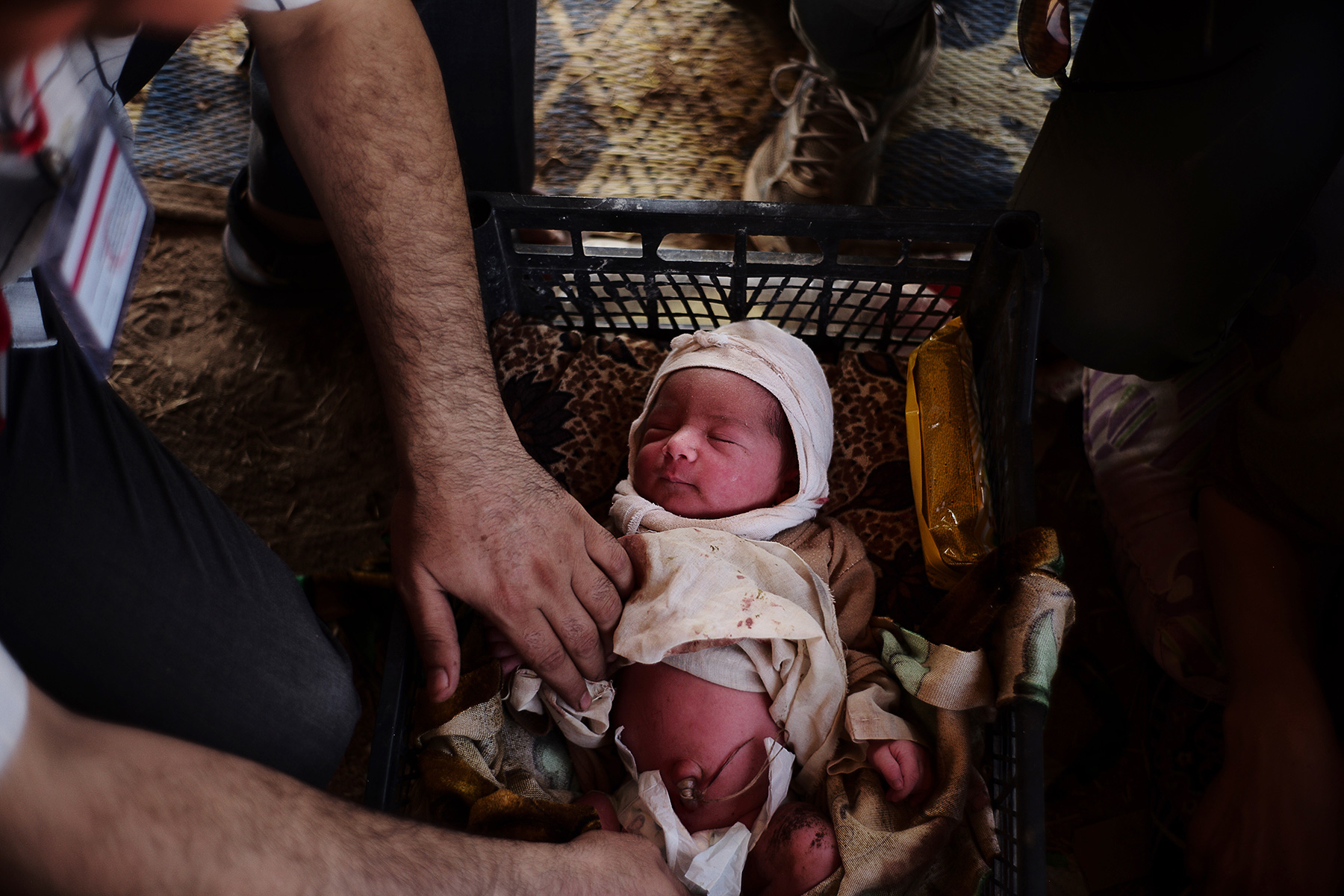
This infant's mother went into labor during the YPG operation to rescue Yazidi families trapped on Mount Sinjar. The boy's name is Farman, meaning "the tragedy," says his father, "to remind him of where he came from." (Click to enlarge images)
That night in Siba Sheikh Khidr, Abbas said, he grabbed his Kalashnikov rifle and told his wife to get ready in case she had to leave without him. There were reasons to be fearful. Like most of his neighbors, Abbas is Yazidi. Followers of the ancient pre-Islamic religion, an estimated 700,000 globally, hold a special veneration for a fallen angel, Melek Taus, whose remorseful tears, they say, extinguished the fires of hell and brought the angel back to God. IS fighters and others call Melek Taus "Satan" and Yazidis “devil worshippers.” The Yazidis, like many minorities in the Middle East, have long lived near mountains, seeking safety in their remoteness.
The cell-phone network was overloaded, so Abbas ran to his brother’s house and told him to gather as many men as he could. According to interviews with four survivors, perhaps 1,000 men — butchers, bakers, carpenters, young and old, most of them civilians — assembled near the military checkpoint in Siba Sheikh Khidr to form the only line of defense between IS and the city of Sinjar. Most of the Iraqi and peshmerga security forces that guarded the checkpoint in Siba Sheikh Khidr had fled, survivors said. The only ones who remained were Yazidi.
Abbas, a soldier in the Iraqi Army, and his brother, a member of the federal police, were among them. “We have to build a wall between Daash and Sinjar,” Abbas told his brother, the two of them filling empty rice sacks with stones, which they then used to barricade the road to town.
Of all the bombings in Iraq this past decade, Siba Sheikh Khidr had seen the worst. In 2007, multiple suicide truck bombs killed more than 500 people there in what is considered to be the singe deadliest attack of the Iraq War. After the attack, the Iraqi government constructed a dirt berm perimeter to protect the town, making the only passage to the heartland of the Yazidis a single road. That night, Abbas and the others took positions on the berm around that road, waiting for the IS convoy to arrive.
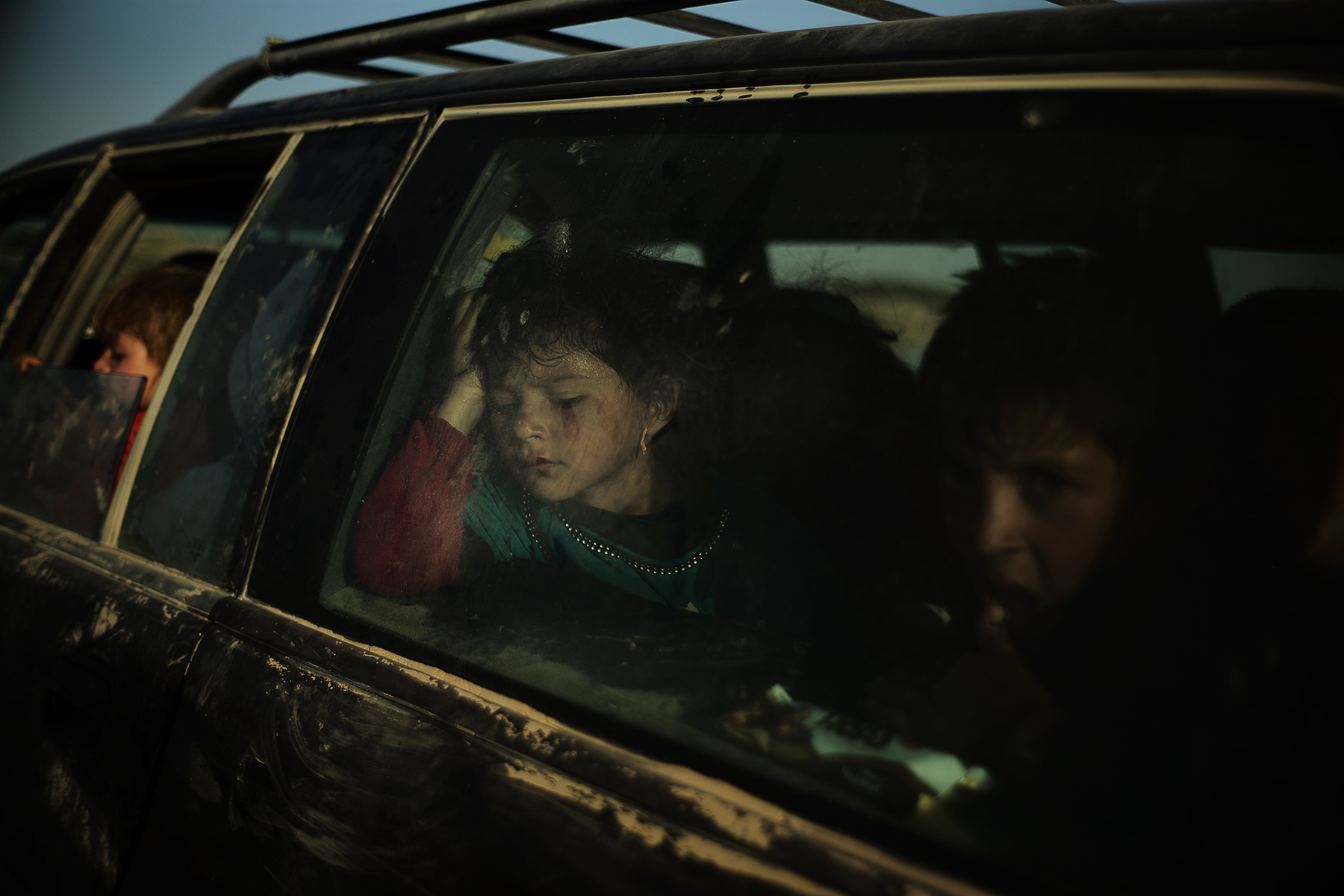
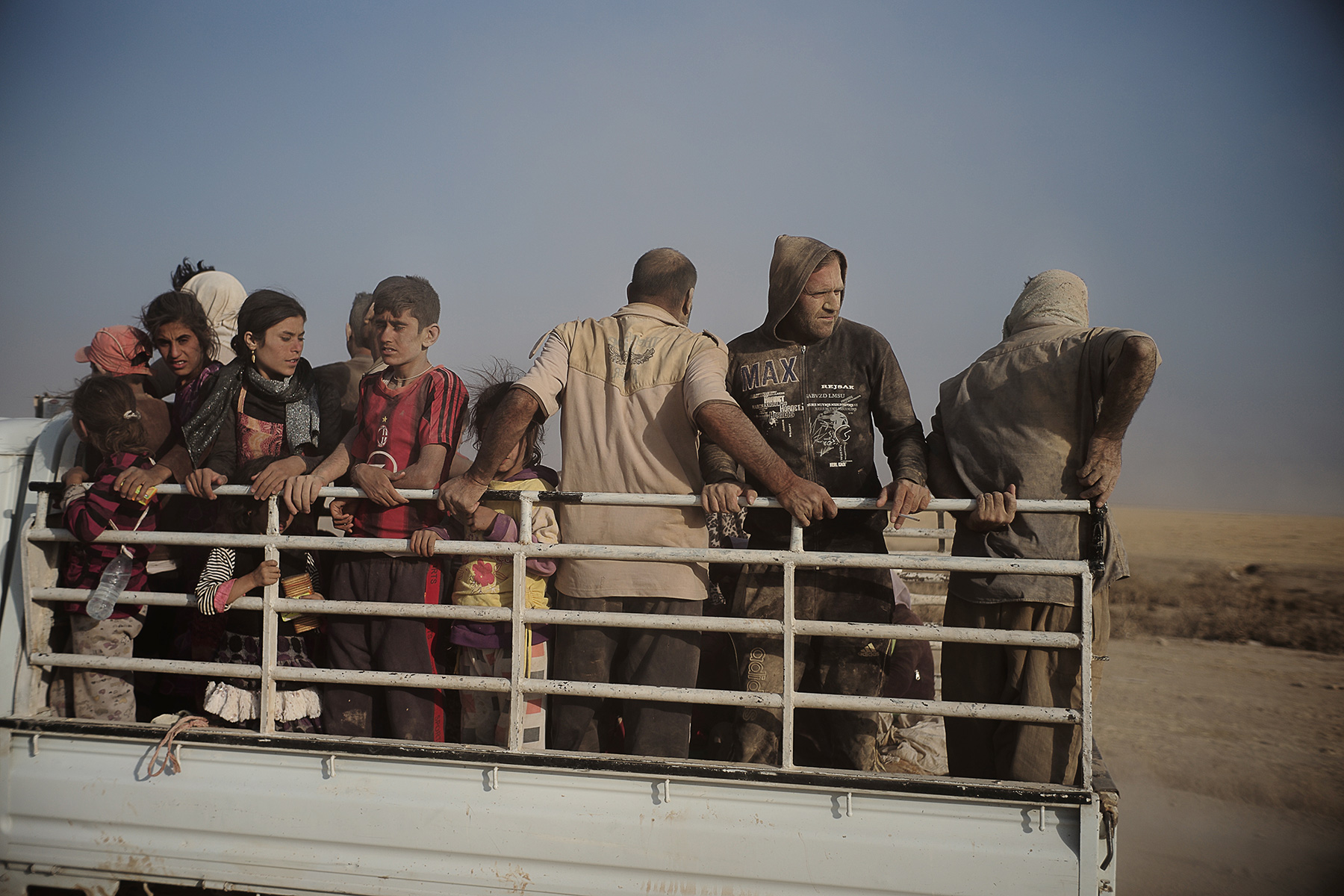
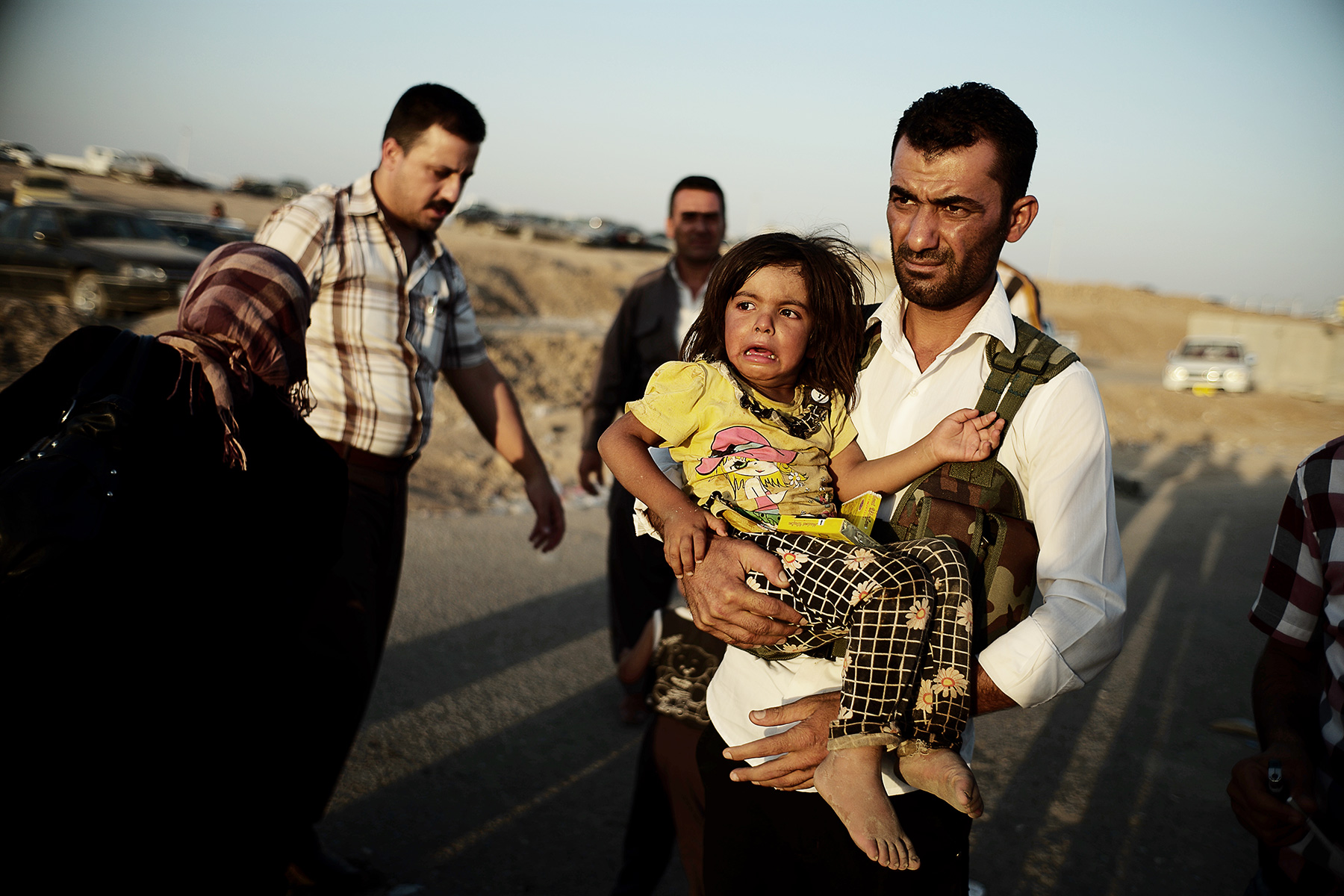
Top: Driven by Syrian volunteers, a Yazidi family from Sinjar waits to cross the Syrian-Iraqi border. Left: Refugees faced malnutrition, dehydration and death atop the mountain. Right: A member of the peshmerga carries a young girl who lost her parents fleeing IS, near Erbil. (Click to enlarge images)
The IS fighters came in pickup trucks at first — more than 20, survivors said, each mounted with a Soviet-era machine gun known as the dushka. Like many Iraqi civilians, the people of Siba Sheikh Khidr kept Kalashnikovs in their homes for protection. That night, the villagers used them to fire on the incoming Daash convoy, forcing it off the road.
When, after three hours of clashes, Daash pickup trucks failed to break through the Yazidis’ defenses, fighters in Siba Sheikh Khidr said they saw four U.S.-made Humvees driving toward them from the direction of the Syrian border. The armored vehicles had likely fallen into IS hands in June, when the Sunni fighters overran Mosul, Iraq’s second-largest city. “The Humvees ran over our barricade and opened the road for the pickup trucks,” said Faisal Qassim, one of the survivors. “Without the Humvees, we could have stopped them.”
By 8 a.m., after five hours of fighting, the Battle of Sinjar was lost. With no military assistance from Iraq’s central or Kurdish governments, the Yazidis had failed to hold the road and prevent Sinjar from falling to the Islamic State. They had, however, bought their brethren precious time to prepare an evacuation. As the Humvees drove past the barricades and on to Sinjar, Abbas said, survivors from the battle gathered their families and fled. The only way out was up and over Mount Sinjar, a mountain range more than 60 miles long and almost 5,000 feet high.
Tens of thousands of Yazidis would be stranded in there in the coming days, surrounded by IS fighters and facing death from malnutrition, dehydration and exposure. On Aug. 8, the United States launched airstrikes to repel IS forces and dropped pallets of food and water. But it was a group of Syrian Kurdish fighters known as the People’s Protection Units, or YPG, who fought through IS-controlled territory in Syria to establish a safe corridor to rescue many of the Yazidis from the mountain. The YPG fighters are the Syrian brand of the Kurdistan Worker’s Party, or PKK, which has been designated a terrorist group by the United States. They are seeking to establish an independent Kurdish state in northeastern Syria.

Tuesday, March 29, 2016

ISIL claims Baghdad suicide attack that killed seven

The armed group Islamic State of Iraq and the Levant has claimed responsibility for a suicide bombing in central Baghdad that police said killed seven people and wounded 27.
The blast occurred on Tuesday near a gathering of workers in Tayaran Square, about a kilometre from a sit-in held by supporters of influential Shia cleric Moqtada al-Sadr to demand political reforms.
ISIL (also known as ISIS), which claimed responsibility in an online statement, also said it was behind a suicide bombing last Friday that killed 26 people at an amateur football game in Iskandariya, south of Baghdad.
Phone camera captures suicide bombing in Iraq stadium
At least 60 people were also killed earlier this month in an attack further south in Hilla when an explosives-laden fuel tanker slammed into an Iraqi security checkpoint.
Some analysts say the escalation of bombings targeting areas outside ISIL's primary control in northern and western Iraq suggests that Iraqi forces may be stretched thin after recent gains against the armed group.
Analysts in Europe have interpreted recent attacks there, such as last week's bombings in Brussels or the killings in Paris last November, as a sign that ISIL is expanding its field of action in response to setbacks in Iraq and Syria, where it governs a self-styled Islamic caliphate. 
But Baghdad analysts said the group has long staged indiscriminate suicide bombings and see these attacks as a continuation of that tactic.
Meanwhile,  the Combined Joint Task Force against ISIL said on Tuesday that the United States and its allies conducted four air strikes against ISIL on Monday.
A statement said four strikes near three cities in Iraq hit a bed-down location and a safe house, destroyed five assembly areas, and suppressed a machine gun position.
Elsewhere in Fallujah, Iraqi army shelling targeting ISIL hideouts killed four people, including two children. At least nine people, mainly women and children, were also wounded.
About 400 ISIL fighters are still in Fallujah, which fell to the armed group more than two years ago.

Thursday, March 10, 2016

US 'will act' if Iran missile tests violated deal

US Vice President Joe Biden has said that the United States would take action against Iran if its recent long-range ballistic missile tests were carried out in defiance of an international deal reached last year over Iran's nuclear programme.
"I want to reiterate, as I know people still doubt, if in fact they break the (nuclear) deal, we will act," Biden said on Wednesday during a visit to Israel and the Palestinian territories.
Biden spoke after meeting Israeli Prime Minister Benjamin Netanyahu, who forcefully opposed the nuclear accord with Iran, his country's arch-foe.
Iranian leaders on Tuesday threatened to abandon the international agreement if it conflicts with Tehran's "national interests" - just hours after the missiles were launched, which violate UN Security Council resolutions.
“If our interests are not met under the nuclear deal, there will be no reason for us to continue,” Abbas Araqchi, Iran’s deputy foreign minister, warned during remarks delivered to a group of Iranian officials in Tehran.”
Iran also said it fired two more long-range ballistic missiles on Wednesday as it continued military tests in defiance of US sanctions and fresh warnings from Washington.
Coming just weeks after the implementation of Iran's historic nuclear deal with world powers, this week's multiple missile tests were described by Iran's powerful Revolutionary Guards as a show of force in the face of US pressure.
After similar tests on Tuesday, Washington warned it could raise the issue with the UN Security Council and take further action after US sanctions were imposed in connection with Iran's missile programme in January.
Ballistic missile tests have been seen as a way for Iran's military to demonstrate that the nuclear deal will have no impact on its plans, which it says are for domestic defence only.
The hard-fought deal, which saw international sanctions lifted in exchange for curbs on Iran's nuclear ambitions, did not extend to its missile programme.
General Amir Ali Hajizadeh, who heads the Iranian Revolutionary Guards' aerospace wing, said the longer-range missiles tested would be capable of hitting Israel, the region's sole if undeclared nuclear power.
Source: AFP

Hamas rejects Egypt allegations over 2015 killing

Hamas has denied Egypt government's allegations accusing the Palestinian group of involvement in the assassination of the country's chief prosecutor last year.
Hisham Barakat was killed in a car-bomb attack in Cairo in June 2015. There was no confirmed claim of responsibility.
In a press conference in Cairo on Sunday, Magdy Abdel-Ghaffar, Egypt's interior minister, said the killing was ordered by Turkey-based leaders from the Muslim Brotherhood group "in close coordination with Hamas".


However, Salah al-Bardawil, a senior Hamas official, said in the Gaza Strip on Monday that the accusations were baseless.
"Hamas denies these political allegations made towards us," he said.
"It has never been a characteristic of us to interfere in Egyptian security affairs."

'No relations with Hamas'

Abdel-Ghaffar had also accused Hamas of providing training to the suspects, allegations that Bardawail denied.
"The suspects have never entered Gaza and have no relations with Hamas," he said before asking the Egypt government to review the "false allegations" in order to avoid straining relations with Palestine.
Egypt has detained 14 people suspected to be involved in assassinating Barakat, accusing them of receiving training in the Gaza Strip.
Gamal Heshmat, a senior member of the Muslim Brotherhood in exile, had also dismissed the accusations as an ongoing effort by the Egyptian government to "demonise" the Brotherhood.
"Their accusations do not contain any credibility; they only reflect failures of politics and security," he told Al Jazeera.
Barakat was the most senior state official to die at the hands of armed groups since the toppling of Mohamed Morsi from the presidency in 2013.
Since then, the Brotherhood was banned and declared a "terrorist" organisation inside Egypt.
UpFront - Is Egypt better off under Sisi?

Iran: Missile tests do not violate nuclear deal

Iran's foreign ministry has insisted that the missile tests carried out by the country's Revolutionary Guard this week did not violate Tehran's nuclear deal with world powers or a UN Security Council resolution.
According to ministry spokesman, Hossein Jaberi Ansari, the missiles were "conventional defensive instruments and they were merely for legitimate defence," the official IRNA news agency reported on Thursday.
Iran's Revolutionary Guard test-launched two ballistic missiles on Wednesday.
It was the latest in a series of recent tests, aimed at demonstrating Iran's intentions to push ahead with its ballistic programme after scaling backing its nuclear programme under the deal reached last year with the US and other world powers.


Ansari said the test-firing "did not defy the Security Council resolution" and added that Iran will continue its missile programme. However, he also said that Iran will remain committed to its international obligations.
"The Islamic Republic of Iran will not compromise over its security and defensive power," said Ansari.
"It will continue it's completely defensive and legitimate missile programme while observing its international commitments and without entering into the fields of either nuclear warheads or designing missiles capable of carrying such warheads," he added.
The landmark nuclear deal, under which Iran accepted to substantially cap its nuclear programme, does not include provisions against missile launches.
When it came into effect on January 16, the Security Council lifted most UN sanctions against Tehran — including a ban it had imposed in 2010 on Iran testing missiles capable of carrying nuclear warheads.
That ban likely would have covered some of the missile fired this week.

To deal with the restrictions in the nuclear agreement, the UN Security Council adopted a resolution last July which among other measures "calls on" Iran not to carry out such tests.
Late on Wednesday, the head of the airspace division of Iran's powerful Revolutionary Guard, General Amir Ali Hejazi, told state TV that the Hebrew markings on the missiles tested earlier in the day were "a choice by colleagues" who worked on the missiles, indicating it was not an official, high-level decision.

Thursday, February 25, 2016

Saudi Arabia is prepared to deploy ground troops to Syria to fight the Islamic State of Iraq and the Levant (ISIL) if US-led coalition leaders agree to the offer.
Saudi's air force has targeted ISIL with air strikes since the campaign began in Syria in September 2014, but the Gulf kingdom is now ready to provide ground forces to defeat the armed group, a military spokesman said on Thursday.
"Today, the Saudi kingdom announced its readiness to participate with ground troops with the US-led coalition against ISIL, because we now have the experience in Yemen," Brigadier General Ahmed Asseri told Al Jazeera.
"We know that air strikes cannot be enough and that a ground operation is needed. We need to combine both to achieve better results on the ground."
Asseri didn't elaborate on how many soldiers the kingdom could send.
The Saudi offer is expected to be discussed when the United States convenes a meeting of defence ministers from coalition countries fighting ISIL in Brussels next week.
Lawrence Korb, a former US assistant secretary of defence, said while Middle East countries have armed and supplied rebels during the five-year Syrian civil war, putting boots on the ground would mark a major shift.
He noted that it may also signal to Russia - whose air power has greatly aided President Bashar al-Assad's recent major military gains - a need to return to Geneva peace negotiations that were postponed this week.
"The fact that you will have Saudi troops on the ground fighting with the rebels against the government is a very significant escalation, and hopefully will get the Russians to these peace talks, rather than thinking they can create a mini-Alawite state in Syria," Korb told Al Jazeera.
A U.S. journalist and three members of her camera crew have been arrested in Bahrain, Reporters Without Borders said on Monday, urging the Gulf kingdom to release the four American citizens "rapidly and without harm."
In a statement, the group described Anna Day and her three colleagues as experienced journalists, who had most recently worked on virtual reality documentaries in Egypt and Gaza. It is believed that the journalists traveled to Bahrain to cover the fifth anniversary of the country's Arab Spring uprising.
A Bahraini police statement issued earlier said authorities had detained four foreign nationals.
Bahrain's interior ministry said in a statement the four were "suspected of offences including entering Bahrain illegally having submitted false information to border staff, and participating in an unlawful gathering."
"One of them was masked and taking part with a group of saboteurs in Sitra in acts of rioting and sabotage and attacks on security officials," the statement said. "The other three were arrested at a security checkpoint in the same area.
The four entered Bahrain between Feb. 11 and 12 and "provided false information to concerned authorities," claiming to be tourists, police said.
The Arabic-language Mira'at al-Bahrain (Bahrain Mirror) said the four were detained in Sitra, a Shia village east of Manama, on Sunday while covering clashes between security forces and pro-democracy protesters marking the anniversary.
The U.S. State Department said it was aware that Americans has been arrested, but had no comment due to privacy concerns.
A friend of Day's, who asked not to be named because of her own work as an independent journalist in hostile areas, said that government accreditation for foreign correspondents in Bahrain can be difficult to get and can imply restrictions, so freelancers commonly work without it.
A representative for Day's family rejected any suggestion that the four were involved in any illegal behavior or non-journalistic activities. Their case has been referred to the public prosecution.
The Committee to Protect Journalists called for the release of the four and noted that at least six other journalists are currently imprisoned in Bahrain in connection with their work.
Day has reported in the Middle East, northern Africa, India, Brazil and Mexico and her work has been published by the New York Times, CNN, Al Jazeera English, Huffington Post, CBS, Daily Beast and other media.
Saudi Arabia, the United Arab Emirates and Bahrain have urged their citizens to leave Lebanon or avoid travelling there.
The move on Tuesday came after Riyadh halted $4bn in aid to Lebanese security forces in response to "hostile" positions linked to Lebanese Shia group Hezbollah.
The Saudi foreign ministry issued a statement calling on "all citizens not to travel to Lebanon, for their safety, and asking citizens residing in Lebanon or visiting not to stay unless extremely necessary".
The statement, run by the official SPA news agency, urged citizens to contact the Saudi Embassy in Beirut.
Announcing the aid halt on Friday, an official said the kingdom had noticed "hostile Lebanese positions resulting from the stranglehold of Hezbollah on the state".
The UAE also banned its citizens from travelling to Lebanon and reduced its diplomatic presence in Beirut.
Bahrain also urged citizens against travelling to Lebanon, and called on Bahrainis there already to leave quickly, according to a statement posted to state news.

READ MORE: Lebanon minister quits over 'Hezbollah domination'

On Friday, the United Arab Emirates announced "full support" of Saudi's review of its relations with Lebanon, blaming the country's "failure to condemn Iran's aggression" after Saudi Arabia's embassy was attacked in Tehran in January.
The embassy attack followed the execution of a renowned Shia leader in Saudi Arabia over "terrorism" charges. 
"The UAE fully supports the Kingdom of Saudi Arabia's decision to halt its aid to the Lebanese army and security forces," said the UAE's foreign ministry statement, posted on state media on Tuesday.
"At the same time [the UAE] calls upon Lebanon and its people to restore Lebanon to the Arab Nation where it belongs, away from the Iranian influences adopted by the so-called Hezbollah," the UAE statement added.  

Thursday, January 14, 2016

Deadly car bomb targets police post in southeast Turkey


Deadly car bomb targets police post in southeast Turkey

At least six dead, dozens injured in blast near police building in predominantly Kurdish Diyarbakir province.

 | War & Conflict, Middle East, Turkey, PKK

  •  
  • 1048
  •   
  • 1
  • All Social
  • Listen to this page using ReadSpeaker

Adjacent housing for police officers was also hit, wounding officers' relatives, local media say [AP]

A car bomb blast near a police building in a Kurdish-majority province in southeastern Turkey has killed six people and injured at least 39 others, officials said.
The bomb attack, blamed by officials on the outlawed Kurdistan Workers Party (PKK), caused heavy damage to outer walls of the police headquarters in the town of Cinar in the province of Diyarbakir, Al Jazeera's Kadir Konuksever, reporting from Diyarbakir, said.
The fighters followed up the bombing with rocket attacks and gunfire, he said, adding that adjacent housing for families of police officers and a private house with civilians inside were also hit.
Three police relatives and three civilians, including two children, who were in the house near the blast, were killed in the incident, he said.
The PKK has been fighting against the Turkish state since 1984, initially for Kurdish independence, although it now presses for greater autonomy and rights for the country's largest ethnic minority. 
Turkish forces and PKK fighters have been engaged in intense clashes in the southeast of the country since a 2013 ceasefire collapsed in July and Turkey started an air campaign against the group.
The conflict has left tens of thousands dead over the years.

Thursday, December 17, 2015

Libyan factions sign UN peace deal

Libyan factions sign UN peace deal

UN deal calls for unity government and cease-fire between factions fighting since death of former leader Muammar Gaddafi

Members of Libya's rival parliaments on Thursday signed a landmark, U.N.-sponsored deal on forming a unity government that will strive to bring peace to the war-ravaged country.
Supporters of the agreement hope that rival political factions and militias will embrace the deal and agree on a cease-fire, so that they can fend off the Islamic State in Iraq and the Levant (ISIL), which is expanding its gains in the North African country.
The document was signed in Morocco by Emhemed Shoaib, the deputy speaker of the internationally recognized Libyan parliament, and Salah al-Makhzoum, the second deputy of the parliament based in the capital, Tripoli.
In the four years since Muammar Gaddafi was killed, Libya has steadily splintered into rival fiefdoms. Over a year ago, it was further torn — in addition to having two parliaments — between the internationally recognized government, based in the country's east, and the government in Tripoli.
The United Nations deal calls for a unity government and a cease-fire that will open the way for international aid and training to rebuild the OPEC oil-producing state.
"We have reached an agreement, but the biggest challenge now is to implement it," said Salah Huma, a parliament member and negotiator for the eastern government, said before the signing.
Al-Makhzoum said while the deal is not perfect, it's a step to rescue Libya from collapsing and ensure its unity.
"This is just the beginning of a long journey for Libya," said U.N. envoy Martin Kobler, who attended the signing ceremony in Morocco. "Signing is only the first step on the road of putting Libya back on the right track."
Western officials believe war fatigue, promises of foreign aid, the strain on Libya's oil economy and the common threat posed by ISIL will help build momentum for the national government and bring opponents onboard
The agreement has detractors on both sides who seek a separate deal without U.N. involvement.
The speakers of the two parliaments — Tripoli-based Nuri A.M. Abusahmain and Aguila Saleh Issa from the east — were not at the Morocco ceremony. The two, who are seen by analysts as hard-liners, held talks on Tuesday in Malta to forge a separate deal without U.N. involvement.
Afterward, they issued a statement saying the representatives who traveled to Morocco were not mandated to represent the parliaments in the talks.
Before the start of Thursday's ceremony, Al-Makhzoum and Faraj Abu-Hashem, the spokesman for the east-based parliament, told The Associated Press that 88 lawmakers from the two parliaments were present at the signing.
The eastern parliament has 156 known members, while the rival parliament in Tripoli has 135.
The foreign ministers of Turkey, Italy, Spain, Qatar, Tunisia, and Morocco also spoke at the ceremony in support of the deal.
Among the first to welcome the deal was French Foreign Minister Laurent Fabius, who praised the accord and promised to support efforts by a new unity government.
"The priority should now go toward creating a national unity government," he said in a statement. "That's the condition for tackling terrorism and trafficking that threaten the security of the region and Europe."
Since the 2011 uprising led to the ousting and killing of Gaddafi, Libya has struggled with almost constant instability as heavily armed brigades of former rebels and their political allies squabbled for control.
Battered by protests and attacks, oil production that accounts for most government revenue is now less than half of the 1.6 million barrels per day level prior to 2011.
But last year, fighting intensified when one armed faction took over Tripoli, set up its own government and reinstated the old parliament, the General National Congress. Since then, the recognized government and elected House of Representatives operate out of the east of the country.
In the chaos, Islamic State fighters have reportedly expanded their presence, taking over the city of Sirte, attacking a hotel and a prison in Tripoli, ransacking oilfields to the south of Sirte and executing a group of Egyptian Christians.

Israel, Turkey reach preliminary agreement to restore diplomatic ties

Israel, Turkey reach preliminary agreement to restore diplomatic ties

The agreement comes five years after Israel killed 10 Turks in a raid on a ship attempting to break the Gaza seige

Israel and Turkey have reached a preliminary agreement to normalize relations, including the return of one another’s ambassadors to both countries, an Israeli official said Thursday. The deal comes five years after relations reached a low point for the two countries over a deadly Israeli raid on a ship carrying Turkish activists attempting to break Israel's blockade on Gaza.
The deal was reached during a recent meeting in Switzerland between Turkish Foreign Ministry Undersecretary Feridun Sinirlioglu and the incoming head of Israel's Mossad intelligence agency, Yossi Cohen, as well as Israeli envoy Joseph Ciechanover, the official said, speaking on condition of anonymity.
A spokesman for Israeli Prime Minister Benjamin Netanyahu declined comment, and there was no immediate comment from the Turkish Foreign Ministry.
A U.S. official familiar with the agreement confirmed the details. He also spoke on condition of anonymity because he wasn't allowed to talk to the media about the subject.
Under the preliminary agreement, Israel will establish a compensation fund of $20 million to address the killing by Israeli marines of 10 Turks aboard the Mavi Marmara, a ship carrying Palestine-solidarity activists attempting to break Israel's blockade of the Gaza Strip in 2010, the official said. In return, Turkey will drop all legal claims against Israel over the incident.
The once-strong Israel-Turkey alliance has soured dramatically over the past 10 years under former primer minister and current Turkish president Recep Tayyip Erdogan, who heads the AK Party. Relations reached a low with the raid on the Gaza-bound ship.
Efforts at reconciliation, including a 2013 phone call between Erdogan and Netanyahu that was brokered by U.S. President Barack Obama, have yet to yield a final deal restoring full diplomatic ties.
With recent tensions between Turkey and Russia, Israeli officials say Ankara has expressed new interest in importing natural gas from Israel.
According to the agreement reached in Switzerland, the unnamed Israeli official said, the countries will discuss the possibility of constructing a pipeline to supply Turkey with gas from Israel's offshore fields.
Turkey will also expel Saleh al-Aruri, a senior member of Hamas' Al-Qassam Brigade, Israeli newspaper Haaretz reported.  
Earlier this week, Erdogan had signaled a possible warming of relations with Israel, saying in published comments that the entire region would benefit from the normalization of ties.

Wednesday, December 16, 2015

Iraq says Turkish troops in ‘violation’ of international law


Iraq says Turkish troops in ‘violation’ of international law

© Ilyas Akengin, AFP file picture | Baghdad says 150 Turkish troops, backed by up to 25 tanks, have been deployed to the area
Text by NEWS WIRES
Latest update : 2015-12-05

The presence of Turkish troops near the Islamic State-held city of Mosul in northern Iraq is a "violation" of international law, Iraq's president said Saturday.

President Fuad Masum called the move a "violation of international norms, laws and Iraq's national sovereignty," and said it was contributing to increased tensions in the region.
Hakim al-Zamili, the head of parliament's security and defense committee, went a step further, calling on Iraq's prime minister to launch airstrikes against the Turkish troops if they remained in Iraqi territory.
Turkey has said a military battalion equipped with armored vehicles has been in the Bashiqa region close to Mosul in the northern Ninevah province for the last five months as part of a training mission to help forces fighting the Islamic State group. Mosul fell to the extremists in June 2014 amid a stunning collapse of Iraqi security forces.
Plans to try to retake Mosul last spring were sidelined as the extremist group advanced on other fronts.
TURKEY SENDS 150 TROOPS AND TANKS CLOSE TO THE NORTHERN IRAQ CITY OF MOSUL

The founder of the training camp outside Mosul, former Ninevah governor Atheel al-Nujaifi, told The Associated Press that the Turkish trainers were at his base at the request of Iraqi Prime Minister Haider al-Abadi and Defense Minister Khaled al-Obeidi. He said the Turkish forces are training but not arming Sunni fighters.
"They didn't give us any weapons even though we asked them to," he said. "We equipped this force from the black market with our own money and we believe they're the best force to liberate Mosul... These people will be very effective to hold ground because they are from there and there'll be no resistance to them from local people."
Sunni fighters in Ninevah and the western Anbar province say the Shiite-dominated government has failed to provide them with the support and weaponry needed to defeat the IS group. The government fears that arming Sunni tribes and militias could backfire. Sunni grievances were a key factor fueling the rise of the IS group, and many Sunnis initially welcomed the extremists as liberators.
The U.S.-led coalition launched 12 airstrikes on IS targets in Iraq on Friday, including two near Mosul targeting tactical units and fighting positions.