Showing posts with label Connor Reed. Show all posts

Wednesday, April 13, 2016

Saudi King Salman announced Friday an agreement with Egypt to build a bridge over the Red Sea connecting the two countries, on the second day of his visit to Cairo.

The Saudi monarch made the announcement in televised comments after meeting Egyptian President Abdel Fattah al-Sisi.
"I agreed with my brother, his Excellency President Abdel Fattah al-Sisi, to build a bridge connecting the two countries," Salman said.
"This historic step to connect the two continents, Africa and Asia, is a qualitative transformation that will increase trade between the two continents to unprecedented levels," he added.
A beaming Sisi, who had minutes before presented the king with the ceremonial Nile Collar, suggested they name the bridge "King Salman bin Abdel Aziz Bridge".
Following the announcement, representatives of both countries signed 17 investment deals and memorandums of understanding.
A government official had said the deals agreed with Saudi Arabia throughout Salman's visit would amount to about $1.7 billion (1.5 billion euros).
They included an agreement to set up a university and homes in South Sinai, and a power plant.
Sunni ties that bind
Saudi Arabia -- along with other Gulf kingdoms such as Kuwait and the United Arab Emirates – showered Egypt with billions of dollars in economic aid after Sisi ousted democratically-elected President Mohammed Morsi in 2013 following mass protests.
But falling oil prices have increased the pressure on Saudi Arabia and other oil-rich Gulf economies. Egypt is also struggling to jumpstart the country’s floundering economy.
Despite the countries precarious economic outlooks, Saudi-Egypt ties remain strong with the region increasingly split between Sunni powers and Iran, the world’s Shiite powerhouse.
With Iraq, Syria and Yemen immersed in civil war, and Saudi Arabia preoccupied by its region-wide rivalry with Iran, Riyadh is determined to stop the Egyptian state from failing. Saudi Arabia will likely continue giving aid to Egypt despite its own budgetary concerns, analysts say.
(FRANCE 24 with AFP, REUTERS)
Date created : 2016-04-08

A suicide bomber detonated an explosives-laden belt near a football stadium in the southern Yemeni port city of Aden on Tuesday, killing at least four people, witnesses and a security source said.

Ten people were wounded in the attack, which appeared to target young army recruits waiting for buses outside a military checkpoint in the city's north, the witnesses and source added.
There was no immediate claim of responsibility for the attack but jihadist militants have carried out similar suicide bombings in Aden in the past.
Such groups are not involved in a nationwide truce that started between the main warring parties in Yemen this week.

Thursday, March 31, 2016

Saudi Arabia and Yemen swap prisoners ahead of planned peace talks

© Ahmad Al-Basha, AFP | A Yemeni fighter loyal to Yemen's ousted president, Abd-Rabbu Mansour Hadi, fires from a tank during clashes with Shiite Houthi rebels west of the city of Taiz, on March 21, 2016
Text by NEWS WIRES
Latest update : 2016-03-28

A Saudi-led military coalition on Monday said it had completed a prisoner swap in Yemen, exchanging nine Saudi prisoners for 109 Yemeni nationals ahead of a planned truce and peace talks aimed at ending the year-long war with Houthi rebels.

The statement did not say which group the deal was made with, but the Iran-allied Houthi movementsaid on Sunday it had exchanged prisoners with its enemy Riyadh, as a first step towards ending a humanitarian crisis prompted by the conflict.
The Iran-allied Houthis are battling Yemeni government forces backed by a Saudi-led military coalition.
Saudi Arabia received its nationals on Sunday, the coalition statement published on Saudi Arabia’s state news agency SPA said. The alliance “hopes to begin a truce in conflict areas of the Republic of Yemen,” it added.
Yemeni media said that the nine men were soldiers. The released Yemenis had been detained during operations in Yemen, SPA said.
News site Yemen Now published a photo of a group of smiling, waving men in white robes and keffiyeh head scarves, which it said was of the soldiers. Reuters was not immediately able to verify the image.
The agreement is one of several prisoner swaps between the two sides since late last year in a conflict which has killed more than 6,000 people and triggered a humanitarian crisis in the Arab world’s poorest country.
Last week the United Nations said the warring parties had agreed to a cessation of hostilities starting at midnight on April 10 and peace talks in Kuwait as part of a fresh push to end the crisis following two rounds of failed talks last year.
The leader of the Houthis said on Friday he wanted peace efforts to succeed but said his group was ready to confront its enemies if violence persisted.
The main battle between the Houthis and the Yemeni government backed by the coalition has led to a power vacuum in parts of the country, allowing al Qaeda and Islamic State-linked fighters to take advantage.
Air raids killed 14 men suspected of belonging to al Qaeda in southern Yemen on Sunday, medics and local residents said, in one of the largest U.S.-led assaults on the group since a civil war broke out a year ago.


The Pentagon has created a new medal to honor the thousands of U.S. troops who have deployed to Iraq or Syria to support operations against Islamic State militants.
The Operation Inherent Resolve Campaign Medal will be awarded to service members who have deployed to Iraq or Syria or its airspace or territorial waters since June 15, 2014, a defense official said.
About 11,000 troops are already eligible for the new medal, which Defense Secretary Ash Carter will announce Wednesday.
To qualify, individuals must spend at least 30 consecutive days in Iraq or Syria or a total of 60 nonconsecutive days, a defense official said.
The 30-day minimum time threshold will be waived for any service member who is injured and evacuated out of the country or who engages in combat.
Thousands of troops will be eligible for the new medal. Previously troops who deployed to Iraq were eligible to receive a Global War on Terror Expeditionary Medal. Troops who received that medal for past deployments will be allowed to exchange that medal for the new OIR medal.
The medal will feature a bronze disc 1¼ inches in diameter engraved with a scorpion and chain-mail covered hand. The ribbon will be striped with blue, teal, sand and orange stripes.
The new medal comes almost two years after the U.S. began sending troops back to Iraq in response to the extremist group, also known as ISIS or ISIL.
There are no more than 3,870 U.S. troops in Iraq but when including those troops on “temporary” deployment, the number is closer to 5,000, defense officials say. Troops on temporary deployment may still qualify for the medal if they meet the 30-day minimum threshold.
Eligibility for the Iraq Campaign Medal was ended in 2011 after the withdraw of U.S. troops.
 

The village of Al-Asriya, south of Baghdad, prepared Saturday to bury its sons, killed when a suicide bomber blew himself up after a football tournament.

The attacker, who himself looks like a teenager on a photo distributed by the Islamic State group that claimed the attack, cut through the crowd when trophies were being presented.
"There are 32 dead and also 84 wounded, 12 of whom are in critical condition," an official in Babil province health directorate told AFP.
"Seventeen of those killed are boys aged between 10 and 16," the official said.
The village of Al-Asriya lies near Iskandariyah, a town about 40 kilometres (25 miles) south of the capital.
The bomber detonated his suicide vest late afternoon on Friday as local officials were handing trophies to the players after a local tournament.
A video posted on social media shows a local official speaking in front of a table covered with trophies and calling out the name of a player before a huge blast.
The footage cuts off with a big flash of yellow light.
"The suicide bomber cut through the crowd to approach the centre of the gathering and blew himself up as the mayor was presenting awards to the players," Ali Nashmi, an 18-year-old eyewitness, told AFP.
The mayor, Ahmed Shaker, was among the dead, as was one of his bodyguards and at least five members of the security forces.
Pictures posted on social media of the blast site showed mangled goal posts smeared with blood.
The United States state department extended its condolences to the bereaved in a statement, as did the United Nations special envoy to Iraq.
IS has been losing territory steadily in Iraq for almost a year.
In the most recent operations, Iraqi forces have been gaining ground in the western province of Anbar and have just begun their reconquest of the province of Nineveh.
Observers have warned that, as their self-proclaimed "caliphate" shrinks towards extinction, IS fighters are likely to revert to their old guerrilla tactics and ramp up suicide attacks on civilian targets.
(AFP)

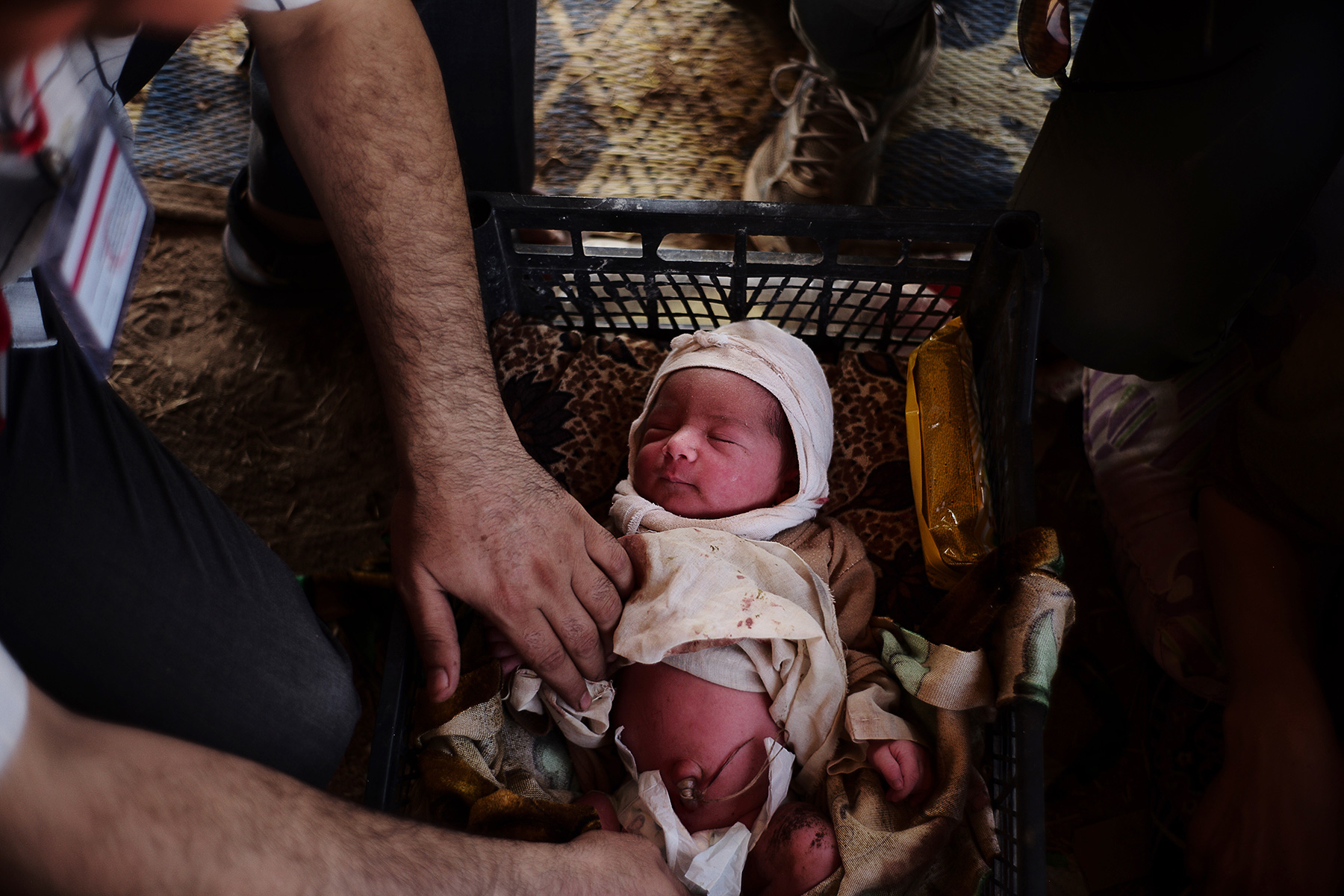
SINJAR, Iraq — Khodeda Abbas is one of the saved. His wife went into labor coming off the mountain and needed medical assistance right away. The couple had just arrived at a shabby medical tent 20 kilometers from Mount Sinjar, along with hundreds of other refugees rescued in tractors, buses and cattle trucks. The drivers were all volunteers, men with enough gasoline and empathy to cross the desert and take exhausted strangers from Iraq into Syria over a border made only of dust. The tent had run out of medical supplies three days earlier.
It was here that Abbas smoked the best cigarette of his life, he said, after becoming a father to the sleeping baby in the milk crate by his feet. He named the child Farman. “It means ‘the tragedy,’” he said, “to remind him of where he came from.”
The tragedy in question began nine nights earlier, on Aug. 3. News of it arrived through the screams of the neighbor banging on Abbas’s door in the village of Siba Sheikh Khidr, on the outskirts of Sinjar town in northwestern Iraq: “Peshmerga have left. Daash are coming.” (Peshmerga are Kurdish security forces; Daash refers to the Islamic State, or IS — the armed Sunni fighters who are seeking to establish an independent state crossing the current borders of Iraq and Syria.)
In recent weeks, IS forces have advanced deeper into Syria and overtaken cities in northern Iraq, killing, imprisoning and evicting those who don’t submit to their cause. Kurdish forces in both countries have also been taking advantage of the current chaos to expand their territories. Here, the border between northwestern Iraq and northeastern Syria has effectively disappeared. Alliances are shifting and national identities are being discarded; many are turning to those they fear the least.
This infant's mother went into labor during the YPG operation to rescue Yazidi families trapped on Mount Sinjar. The boy's name is Farman, meaning "the tragedy," says his father, "to remind him of where he came from." (Click to enlarge images)
That night in Siba Sheikh Khidr, Abbas said, he grabbed his Kalashnikov rifle and told his wife to get ready in case she had to leave without him. There were reasons to be fearful. Like most of his neighbors, Abbas is Yazidi. Followers of the ancient pre-Islamic religion, an estimated 700,000 globally, hold a special veneration for a fallen angel, Melek Taus, whose remorseful tears, they say, extinguished the fires of hell and brought the angel back to God. IS fighters and others call Melek Taus "Satan" and Yazidis “devil worshippers.” The Yazidis, like many minorities in the Middle East, have long lived near mountains, seeking safety in their remoteness.
The cell-phone network was overloaded, so Abbas ran to his brother’s house and told him to gather as many men as he could. According to interviews with four survivors, perhaps 1,000 men — butchers, bakers, carpenters, young and old, most of them civilians — assembled near the military checkpoint in Siba Sheikh Khidr to form the only line of defense between IS and the city of Sinjar. Most of the Iraqi and peshmerga security forces that guarded the checkpoint in Siba Sheikh Khidr had fled, survivors said. The only ones who remained were Yazidi.
Abbas, a soldier in the Iraqi Army, and his brother, a member of the federal police, were among them. “We have to build a wall between Daash and Sinjar,” Abbas told his brother, the two of them filling empty rice sacks with stones, which they then used to barricade the road to town.
Of all the bombings in Iraq this past decade, Siba Sheikh Khidr had seen the worst. In 2007, multiple suicide truck bombs killed more than 500 people there in what is considered to be the singe deadliest attack of the Iraq War. After the attack, the Iraqi government constructed a dirt berm perimeter to protect the town, making the only passage to the heartland of the Yazidis a single road. That night, Abbas and the others took positions on the berm around that road, waiting for the IS convoy to arrive.
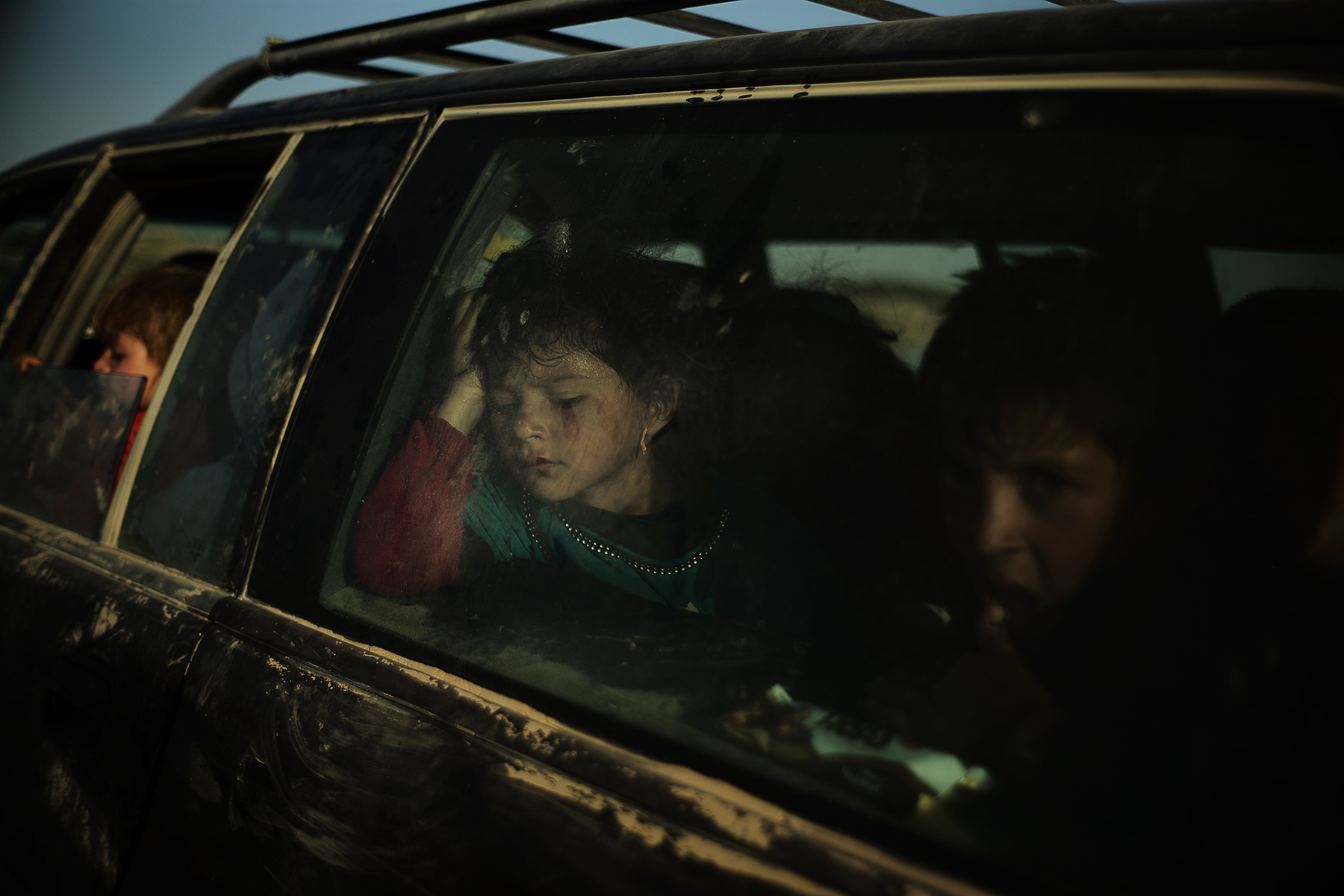
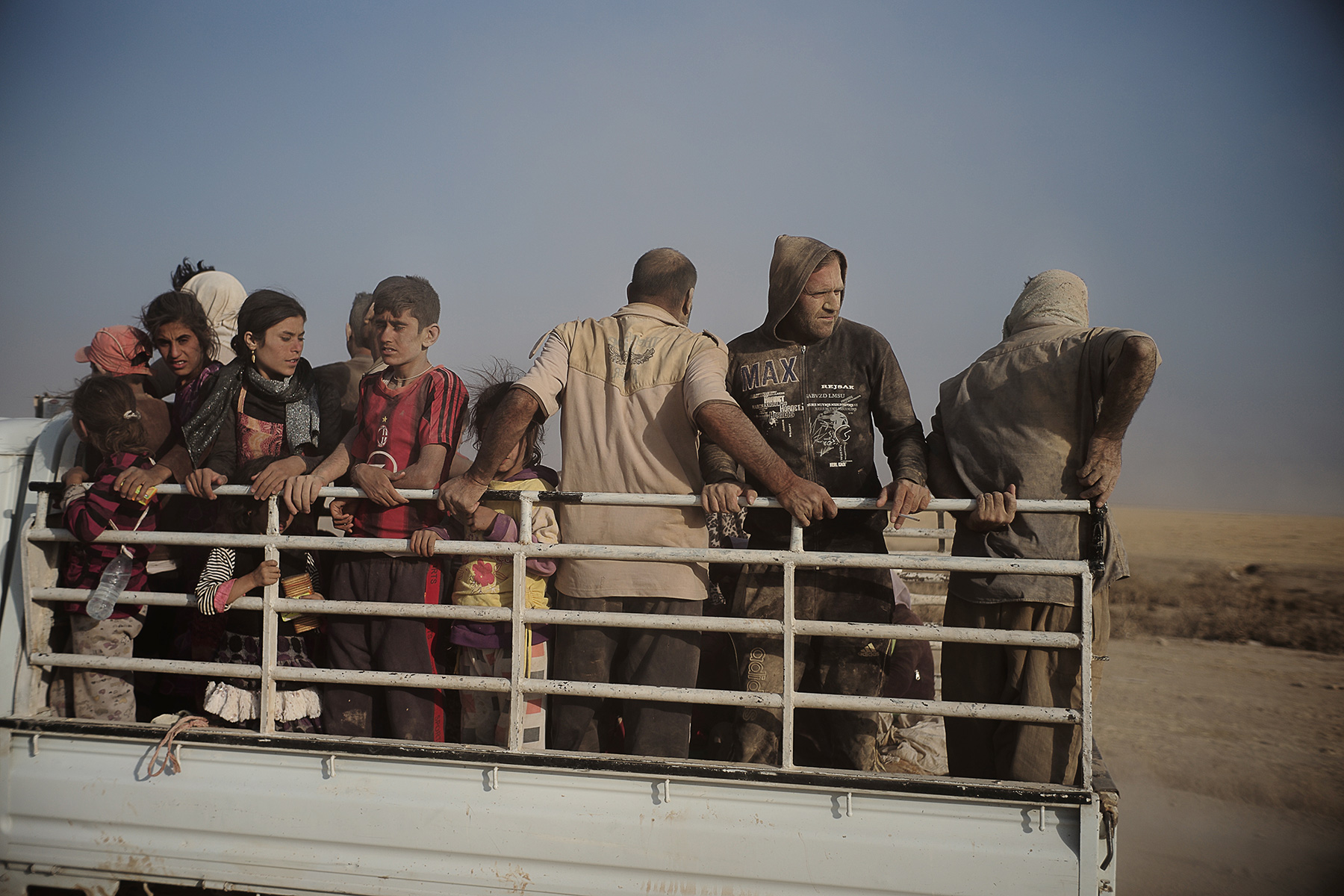
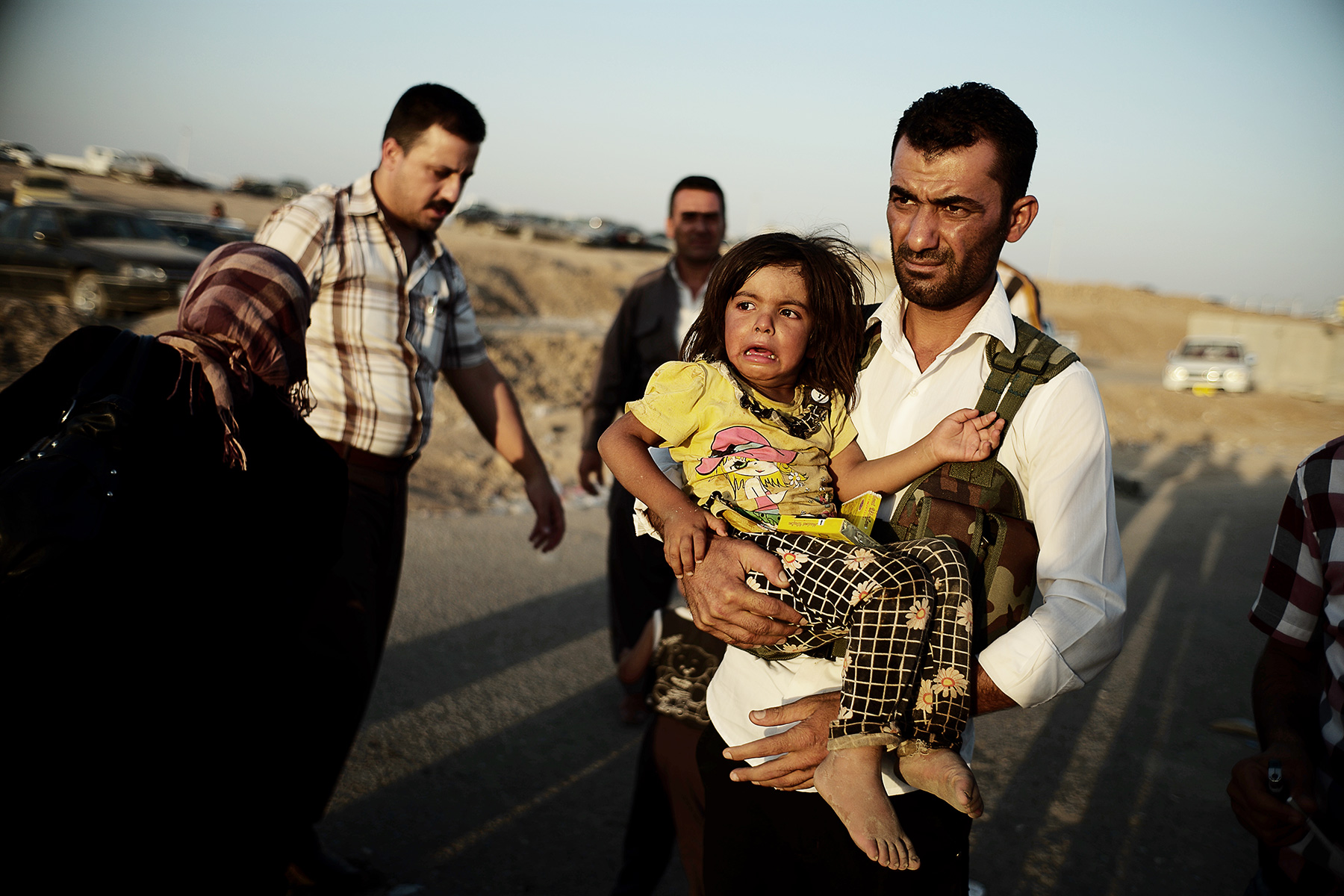
Top: Driven by Syrian volunteers, a Yazidi family from Sinjar waits to cross the Syrian-Iraqi border. Left: Refugees faced malnutrition, dehydration and death atop the mountain. Right: A member of the peshmerga carries a young girl who lost her parents fleeing IS, near Erbil. (Click to enlarge images)
The IS fighters came in pickup trucks at first — more than 20, survivors said, each mounted with a Soviet-era machine gun known as the dushka. Like many Iraqi civilians, the people of Siba Sheikh Khidr kept Kalashnikovs in their homes for protection. That night, the villagers used them to fire on the incoming Daash convoy, forcing it off the road.
When, after three hours of clashes, Daash pickup trucks failed to break through the Yazidis’ defenses, fighters in Siba Sheikh Khidr said they saw four U.S.-made Humvees driving toward them from the direction of the Syrian border. The armored vehicles had likely fallen into IS hands in June, when the Sunni fighters overran Mosul, Iraq’s second-largest city. “The Humvees ran over our barricade and opened the road for the pickup trucks,” said Faisal Qassim, one of the survivors. “Without the Humvees, we could have stopped them.”
By 8 a.m., after five hours of fighting, the Battle of Sinjar was lost. With no military assistance from Iraq’s central or Kurdish governments, the Yazidis had failed to hold the road and prevent Sinjar from falling to the Islamic State. They had, however, bought their brethren precious time to prepare an evacuation. As the Humvees drove past the barricades and on to Sinjar, Abbas said, survivors from the battle gathered their families and fled. The only way out was up and over Mount Sinjar, a mountain range more than 60 miles long and almost 5,000 feet high.
Tens of thousands of Yazidis would be stranded in there in the coming days, surrounded by IS fighters and facing death from malnutrition, dehydration and exposure. On Aug. 8, the United States launched airstrikes to repel IS forces and dropped pallets of food and water. But it was a group of Syrian Kurdish fighters known as the People’s Protection Units, or YPG, who fought through IS-controlled territory in Syria to establish a safe corridor to rescue many of the Yazidis from the mountain. The YPG fighters are the Syrian brand of the Kurdistan Worker’s Party, or PKK, which has been designated a terrorist group by the United States. They are seeking to establish an independent Kurdish state in northeastern Syria.

Thursday, February 25, 2016

Saudi Arabia is prepared to deploy ground troops to Syria to fight the Islamic State of Iraq and the Levant (ISIL) if US-led coalition leaders agree to the offer.
Saudi's air force has targeted ISIL with air strikes since the campaign began in Syria in September 2014, but the Gulf kingdom is now ready to provide ground forces to defeat the armed group, a military spokesman said on Thursday.
"Today, the Saudi kingdom announced its readiness to participate with ground troops with the US-led coalition against ISIL, because we now have the experience in Yemen," Brigadier General Ahmed Asseri told Al Jazeera.
"We know that air strikes cannot be enough and that a ground operation is needed. We need to combine both to achieve better results on the ground."
Asseri didn't elaborate on how many soldiers the kingdom could send.
The Saudi offer is expected to be discussed when the United States convenes a meeting of defence ministers from coalition countries fighting ISIL in Brussels next week.
Lawrence Korb, a former US assistant secretary of defence, said while Middle East countries have armed and supplied rebels during the five-year Syrian civil war, putting boots on the ground would mark a major shift.
He noted that it may also signal to Russia - whose air power has greatly aided President Bashar al-Assad's recent major military gains - a need to return to Geneva peace negotiations that were postponed this week.
"The fact that you will have Saudi troops on the ground fighting with the rebels against the government is a very significant escalation, and hopefully will get the Russians to these peace talks, rather than thinking they can create a mini-Alawite state in Syria," Korb told Al Jazeera.
A U.S. journalist and three members of her camera crew have been arrested in Bahrain, Reporters Without Borders said on Monday, urging the Gulf kingdom to release the four American citizens "rapidly and without harm."
In a statement, the group described Anna Day and her three colleagues as experienced journalists, who had most recently worked on virtual reality documentaries in Egypt and Gaza. It is believed that the journalists traveled to Bahrain to cover the fifth anniversary of the country's Arab Spring uprising.
A Bahraini police statement issued earlier said authorities had detained four foreign nationals.
Bahrain's interior ministry said in a statement the four were "suspected of offences including entering Bahrain illegally having submitted false information to border staff, and participating in an unlawful gathering."
"One of them was masked and taking part with a group of saboteurs in Sitra in acts of rioting and sabotage and attacks on security officials," the statement said. "The other three were arrested at a security checkpoint in the same area.
The four entered Bahrain between Feb. 11 and 12 and "provided false information to concerned authorities," claiming to be tourists, police said.
The Arabic-language Mira'at al-Bahrain (Bahrain Mirror) said the four were detained in Sitra, a Shia village east of Manama, on Sunday while covering clashes between security forces and pro-democracy protesters marking the anniversary.
The U.S. State Department said it was aware that Americans has been arrested, but had no comment due to privacy concerns.
A friend of Day's, who asked not to be named because of her own work as an independent journalist in hostile areas, said that government accreditation for foreign correspondents in Bahrain can be difficult to get and can imply restrictions, so freelancers commonly work without it.
A representative for Day's family rejected any suggestion that the four were involved in any illegal behavior or non-journalistic activities. Their case has been referred to the public prosecution.
The Committee to Protect Journalists called for the release of the four and noted that at least six other journalists are currently imprisoned in Bahrain in connection with their work.
Day has reported in the Middle East, northern Africa, India, Brazil and Mexico and her work has been published by the New York Times, CNN, Al Jazeera English, Huffington Post, CBS, Daily Beast and other media.
Saudi Arabia, the United Arab Emirates and Bahrain have urged their citizens to leave Lebanon or avoid travelling there.
The move on Tuesday came after Riyadh halted $4bn in aid to Lebanese security forces in response to "hostile" positions linked to Lebanese Shia group Hezbollah.
The Saudi foreign ministry issued a statement calling on "all citizens not to travel to Lebanon, for their safety, and asking citizens residing in Lebanon or visiting not to stay unless extremely necessary".
The statement, run by the official SPA news agency, urged citizens to contact the Saudi Embassy in Beirut.
Announcing the aid halt on Friday, an official said the kingdom had noticed "hostile Lebanese positions resulting from the stranglehold of Hezbollah on the state".
The UAE also banned its citizens from travelling to Lebanon and reduced its diplomatic presence in Beirut.
Bahrain also urged citizens against travelling to Lebanon, and called on Bahrainis there already to leave quickly, according to a statement posted to state news.

READ MORE: Lebanon minister quits over 'Hezbollah domination'

On Friday, the United Arab Emirates announced "full support" of Saudi's review of its relations with Lebanon, blaming the country's "failure to condemn Iran's aggression" after Saudi Arabia's embassy was attacked in Tehran in January.
The embassy attack followed the execution of a renowned Shia leader in Saudi Arabia over "terrorism" charges. 
"The UAE fully supports the Kingdom of Saudi Arabia's decision to halt its aid to the Lebanese army and security forces," said the UAE's foreign ministry statement, posted on state media on Tuesday.
"At the same time [the UAE] calls upon Lebanon and its people to restore Lebanon to the Arab Nation where it belongs, away from the Iranian influences adopted by the so-called Hezbollah," the UAE statement added.